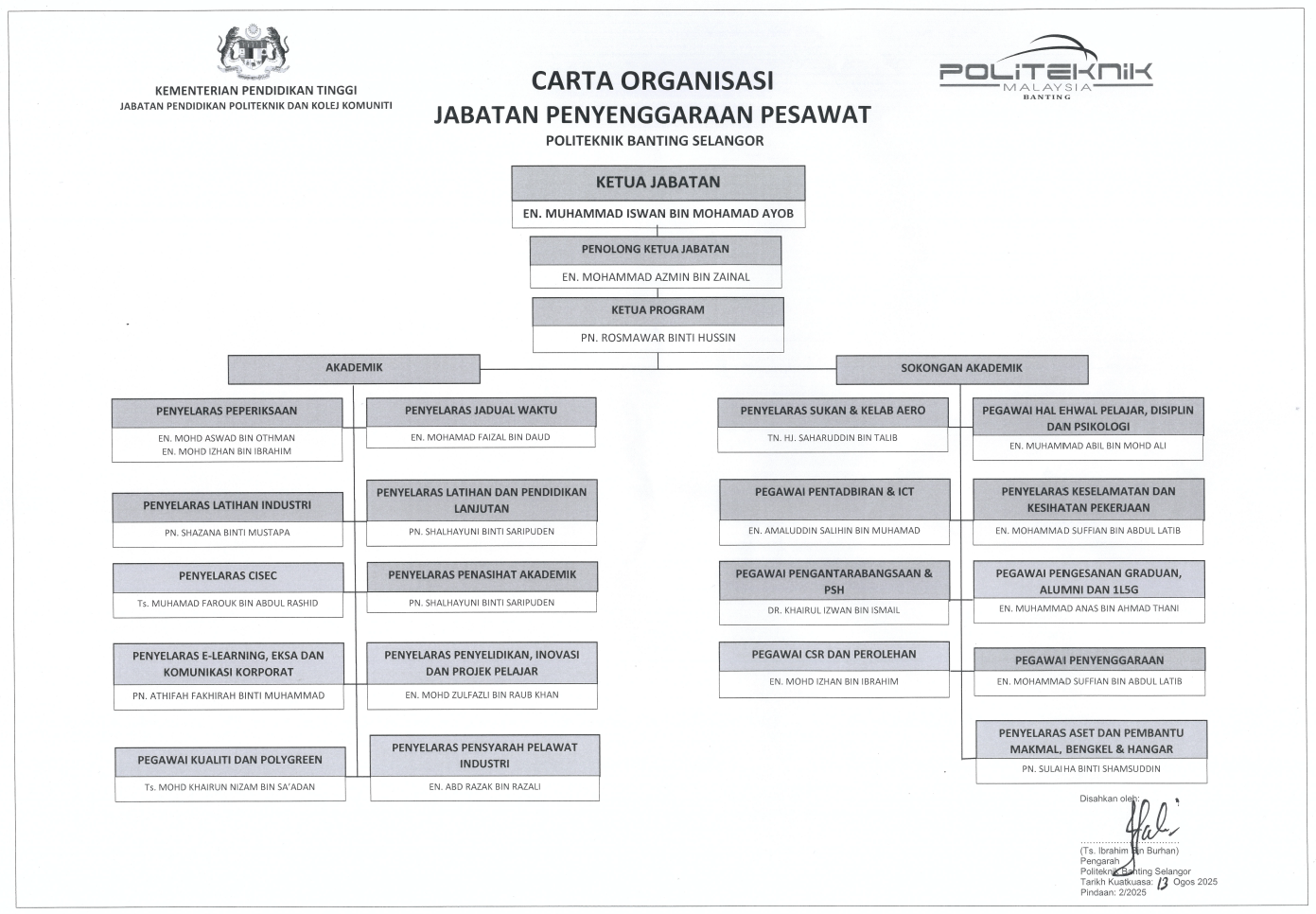
Pengenalan Jabatan Penyenggaraan Pesawat merupakan salah satu jabatan induk di Politeknik Banting Selangor (PBS). Penubuhan awal jabatan ini adalah bermula di Politeknik Sultan Salahuddin Abdul Aziz Shah dengan pengambilan kumpulan pelajar yang pertama pada Sesi Julai 2006. Bermula pada Sesi Disember 2012, jabatan ini dipindahkan ke PBS dan mula beropeasi sepenuhnya. Program di bawah jabatan ini menyediakan pendidikan serta latihan dalam bentuk kuliah, tutorial, tugasan, projek dan amali di bengkel/makmal. Melalui program yang ditawarkan di bawah jabatan ini juga, PBS telah diiktiraf sebagai Approved Training Organization oleh Civil Aviation Authority of Malaysia (CAAM) pada April 2018. Oleh itu, pelajar yang mengikuti kursus ini mempunyai peluang untuk dianugerahkan diploma dan dalam masa yang sama layak memohon Cat A License setelah menamatkan pengajian jika segala syarat dan kelulusan yang ditetapkan berjaya dipenuhi. Akreditasi (Accreditation) Bil Fasiliti 1 Cessna 172N 2 Boeing 737-200 3 Leerjet 4 Helicopter Bell 5 Aircraft Systems Laboratory 6 Aerodynamics Laboratory 7 Simulator Laboratory 8 Non Destructive Testing Laboratroy 9 Electrical And Instrumentation Laboratory 10 Digital Technique Laboratory 11 Computer Based Training Laboratory 12 General Workshop Maklumat lanjut sila hubungi: Jabatan Penyenggaraan Pesawat (JPP) boleh dihubungi melalui: Pejabat:03-3120 1657 / 03-3120 1625 Email Politeknik Banting Selangor:This email address is being protected from spambots. You need JavaScript enabled to view it. SYNOPSIS The Diploma Engineering in Aircraft Maintenance programme is designed to produced holistic graduates that have knowledge and competent skills in the field of aircraft maintenance engineering to fulfil the demand of workers in engineering sector. The programme structure focusses on the area of Aviation Regulation, Maintenance Procedures, Structures and Systems, Power Plant, Avionics and Design. JOB PROSPECT This programme provides the knowledge and skills in Aircraft Maintenance Engineering field that can be applied to a broad range of careers in Aircraft Maintenance Engineering. The knowledge and skills that the students acquire from the programme will enable them to participate in the job market as: PROGRAMME AIM The program believes that every individual has potential and the program aims to develop adaptable and responsible Senior Aircraft Maintenance Technician to support government aspiration to increase workforce in engineering related field. PROGRAMME EDUCATIONAL OBJECTIVES (PEO) Diploma Engineering in Aircraft Maintenance programme should produce balanced and competent technical workers who are: PEO1: equipped with industry-relevant knowledge and skills in aircraft maintenance engineering field. PEO2: engaging on lifelong and continuous learning to enhance their knowledge and skills. PEO3: instilled with entrepreneurial skills and mind set in the real working environment. PEO4: established strong linkage with society and players in the industry. PROGRAMME LEARNING OUTCOMES (PLO) Upon completion of the programme, students should be able to: PLO1: apply knowledge of applied mathematics, applied science, engineering fundamentals and an engineering specialisation as specified in DK1 to DK4 respectively to wide practical procedures and practices PLO2: identify and analyse well-defined engineering problems reaching substantiated conclusions using codified methods of analysis specific to their field of activity (DK1 to DK4) PLO3: design solutions for well-defined technical problems and assist with the design of systems, components or processes to meet specified needs with appropriate consideration for public health and safety, cultural, societal, and environmental considerations (DK5) PLO4: conduct investigations of well-defined problems; locate and search relevant codes and catalogues, conduct standard tests and measurements PLO5: apply appropriate techniques, resources, and modern engineering and IT tools to well-defined engineering problems, with an awareness of the limitations (DK6) PLO6: demonstrate knowledge of the societal, health, safety, legal and cultural issues and the consequent responsibilities relevant to engineering technician practice and solutions to well-defined engineering problems (DK7) PLO7: understand and evaluate the sustainability and impact of engineering technician work in the solution of well-defined engineering problems in societal and environmental contexts (DK7) PLO8: understand and commit to professional ethics and responsibilities and norms of technician practice PLO9: function effectively as an individual, and as a member in diverse technical teams PLO10: communicate effectively on well-defined engineering activities with the engineering community and with society at large, by being able to comprehend the work of others, document their own work, and give and receive clear instructions PLO11: demonstrate knowledge and understanding of engineering management principles and apply these to one’s own work, as a member or leader in a technical team and to manage projects in multidisciplinary environments PLO12: recognise the need for, and have the ability to engage in independent updating in the context of specialised technical knowledge
SYNOPSIS The Diploma Engineering in Aircraft Maintenance programme is designed to produce holistic graduates that have knowledge and competent skills in the field of aircraft maintenance engineering to fulfil the demand of workers in the engineering sector. The programme structure focuses on the area of Aviation Regulation, Maintenance Procedures, Structures and Systems, Power Plant, Avionics and Design. JOB PROSPECT This programme provides the knowledge and skills in Aircraft Maintenance Engineering field that can be applied to a broad range of careers in Aircraft Maintenance Engineering. The knowledge and skills that the students acquire from the programme will enable them to participate in the job market as: PROGRAMME AIM The program believes that every individual has potential and the program aims to develop adaptable and responsible Senior Aircraft Maintenance Technicians to support government aspiration to increase workforce in engineering related fields. PROGRAMME EDUCATIONAL OBJECTIVES (PEO) Within a few years after completing Diploma Engineering in Aircraft Maintenance, graduates are able to: PEO1: proficient with industry-relevant knowledge and skills in the aircraft maintenance engineering field. Upon completion of the programme, students should be able to: PLO 1: PLO 2: PLO 3: PLO 4: PLO 5: PLO 6: PLO 7: PLO 8: PLO 9: PLO 10: PLO 11: *Represented by the 17 UN Sustainable Development Goals (UN-SDG). TARIKH DIKEMASKINI: 22 OGOS 2025INFO JABATAN
Kemudahan dan Fasiliti
PROGRAM PENGAJIAN (2019)
PROGRAM PENGAJIAN (2024)
b. Aircraft Component/Engine/Modification Technician
c. Aircraft Components Manufacturing Technician
d. Aircraft Product Development Technician/Officer/Researcher
e. Aircraft Maintenance Planner
f. Aircraft Non-destructive Testing (NDT) Inspector
g. Aircraft Support Service Technician
h. Aircraft Ground Support Technician
i. Aircraft Components/Spare Sales Representative
j. Helicopter Maintenance Technician/Mechanic - Turbine/Piston Engine
k. Programme Technical Representative Entrepreneur
l. Drone Maintenance/Operator
PEO2: engaging on lifelong and continuous learning to enhance knowledge and skills.
PEO3: acquire with entrepreneurial skills and mindset in the real working environment.
PEO4: established links with society and players in the industry.
PROGRAMME LEARNING OUTCOMES (PLO)
apply knowledge of applied mathematics, applied science, computer and engineering fundamentals and an engineering specialisation as specified in DK1 to DK4 respectively to wide practical procedures and practices in area of aircraft maintenance engineering.
identify and analyse well-defined engineering problems reaching substantiated conclusions using codified methods of analysis specific to aircraft maintenance engineering field (DK1 to DK4).
design solutions for well-defined technical problems and assist with the design of systems, components or processes to meet specified needs with appropriate consideration for public health and safety, cultural, societal, and environmental considerations in area of aircraft maintenance engineering (DK5).
conduct investigations of well-defined problems; locate and search relevant codes and catalogues, conduct standard tests and measurements (DK8).
apply appropriate techniques, resources, and engineering and IT tools to well-defined engineering problems, with an awareness of the limitations (DK2 and DK6).
consider sustainable development impacts* to: society, the economy, sustainability, health and safety, legal frameworks, and the environment, in solving well- defined engineering problems (DK1, DK5 and DK7).
understand and commit to professional ethics and responsibilities and norms of technician practice and including compliance with national and international laws. Demonstrate an understanding of the need for diversity and inclusion (DK9).
function effectively as an individual, and as a member in diverse and inclusive teams in multi-disciplinary, face-to-face, remote and distributed settings (DK9).
communicate effectively on well-defined engineering activities with the engineering community and with society at large, by being able to comprehend the work of others, document their own work, and give and receive clear instructions (NA).
demonstrate awareness of engineering management principles as a member or leader in a technical team and to manage projects in multidisciplinary environments.
recognise the need for, and have the ability for i) independent and lifelong learning and ii) critical thinking in the face of specialised technical knowledge. (DK8).